After my spring trip to Aveyron where I fell under the spell of wild orchids I was hoping to continue my quest with some summer flowering species during our holidays in Ireland. The island is home to a large variety of species and given the cooler and wetter climate in comparison with the continent, I was even hopeful to chance upon some late spring flowering types. Sadly my optimism didn’t last very long, the reality of family holidays and their utter unsuitability for such undertakings rapidly dashed my hopes.
Back in Creuse the flowering season of wild orchids virtually over, I was determined to find at least the one that ends the season, the autumn lady’s tresses, which is the last wild orchid to blossom in the year. My research showed that the closest region where they can be found in the wild is the Puy-de-Dôme, our neighbouring departement.
So on a sunny September morning I set out to find the last wild orchid species of the year.
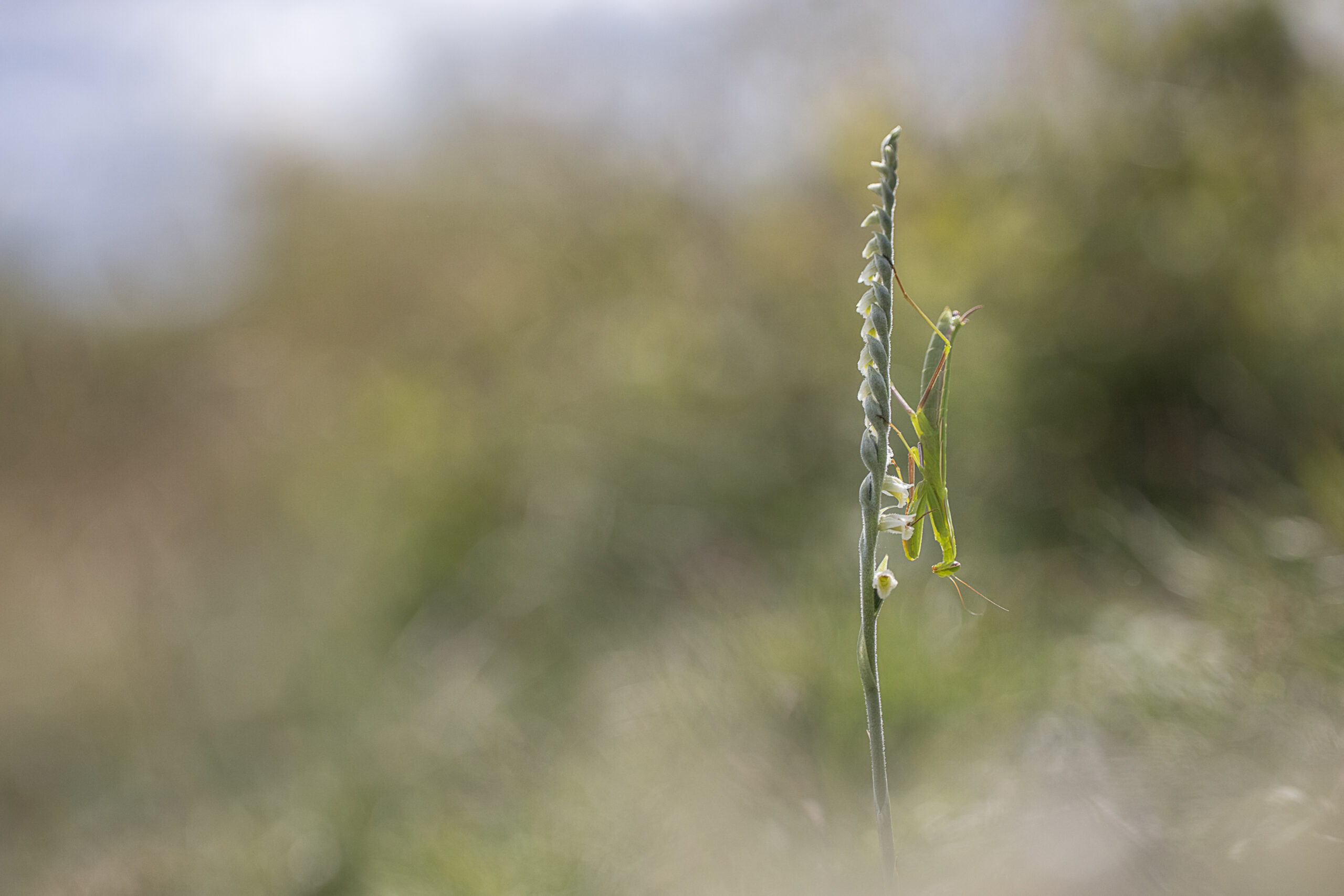
At the end of the summer, the plant’s low rosette of leaves emerges, the tiny white flowers are arranged in a helix around the upper part of a single slightly hairy stalk. You need to look very closely to really appreciate it’s beauty. The stalk does not grow taller than about 6 inches and it’s grey-green appareance due to the tiny hairs make it very unconspicuous and hard to find.

After having spent 2 hours searching in vain in a large dry field, I have to accept the obvious : My undertaking is a real challenge, much harder than I had imagined, even knowing the habitats to look out for, it is virtually impossible to find lady’s tresses without knowing their exact location.
I try my luck in another field a bit further when suddenly something small and green takes off at my feet. I follow it’s flight path, I know already what it is even though I only caught a glimpse. Never in my wildest dreams would I have thought to come across the little beasty here, at nearly 1000 meters altitude ! How on earth does it survive the harsh winters ? It is a species that is normally only encoutered in warm climates. But I was right, there in the low grass is a beautiful green male specimen of praying mantis. A lost individual ? I try and get some images, but the lad is not very cooperative. He keeps flying off, between 5 and 10 meters at a time. Suddenly a second individual takes off, then I see a third one……my theory of the lost male in search for a female crumbles. I follow the third individual and …… I nearly stepped on it, only a few inches away from the mantis in the grass I spot my very first autumn lady’s tresses !

Time flies when you are having fun, the afternoon is over in no time, I find more orchids around 15 – 20 in total, not a very big stand, but I am over the moon all the same. There are more parying mantis too, males, females and juveniles. There is no doubt, they do seem to reproduce around here. Check out this tiny baby mantis:

Whilst a lot of wild orchids grow in light woods, lady’s tresses love the light and grow in dry, open sunny fields. Under those conditions getting good photographs in the harsh afternoon sun is quite a challenge.

So I am back the following week-end, this time I have reserved a room nearby, that way I can be on site early in the moring and towards the end of the day when the light is much more suitable for photography.

When the sun is too high and too hot I leave to investigate other areas in the vicinity. Unfortunately I don’t find any more stands of lady’s tresses, but I do find another great site for mantis. I have never seen so many ! Males, females, juveniles, even though it sounds unbelievable, this warmth loving species seems to thrive in the harsh cold mountainous parts of the Auvergne at 800 meters .
Like this female easily recognisable for its abdomen.

I also found a few brown individuals, populations can adapt to their environment.

I even came across a pale green individual, a male unfortunately unable to fly due to a deformed wing.

You can see the complete series of photographs here: https://karinswildlifediaries.org/?post_type=jetpack-portfolio&p=5172